
Moving to Italy
Geostrata helps Americans move to Italy from the U.S.A. by managing every step of the relocation process.
Why Italy?
Quality of life
Italy offers an exceptional quality of life that is impossible to replicate anywhere else. Italian culture centers around exceptional cuisine, tradition, fine wine, family, and enjoying the simple things in life. Italy’s world-renowned cuisine can inspire a lifetime of discovery, with each region offering its own distinct flavors and culinary heritage.
Italy is home to more UNESCO World Heritage Sites than any other country, allowing residents to experience daily the history and beauty that others travel across the world to see for only a few days or weeks.
Italian culture prioritizes the slow life. Moments like a good coffee, a beautiful sunset, and a laugh with friends are to be savored- not rushed. For many Americans, Italy is the ultimate destination for retirement, remote work, or a different kind of life that celebrates every day as a gift.
Universal healthcare
Healthcare in Italy is considered a fundamental right. Italy’s public healthcare system, Servizio Sanitario Nazionale (SSN), consistently ranks among the top in the world. Italy’s universal healthcare system delivers world-class healthcare for free, or at a very affordable price. Medical debt is virtually non-existent in Italy.
Italy also has world-class private healthcare services. It is possible for Americans to buy-in to Italy’s universal healthcare system for a nominal annual fee. All Americans are required to hold a government-approved private healthcare policy until they are enrolled in Italy’s public healthcare system. Geostrata will help you enroll in the right policy and prepare you for enrollment in Italian public healthcare when you are eligible.
Cost of living
Italy’s overall cost of living is 40% to 50% lower than the United States. Everyday purchases like food, medicines, and meals cost far less in Italy than in the U.S.
Beautiful apartments in cities like Florence and Rome can rent for $1,300 per month. Rents in smaller cities or towns are significantly lower than that. According to Redfin, the median sale price for a basic house in California is around $780,000. There are sprawling villas listed in places like Tuscany for half of that.
Cost of living is one of the most important factors for many of Geostrata’s clients, especially retirees living on a fixed income. Your income and Social Security go much further in Italy than in most U.S. markets, allowing for a more fulfilling retirement and peace of mind.
Education system
Natural beauty
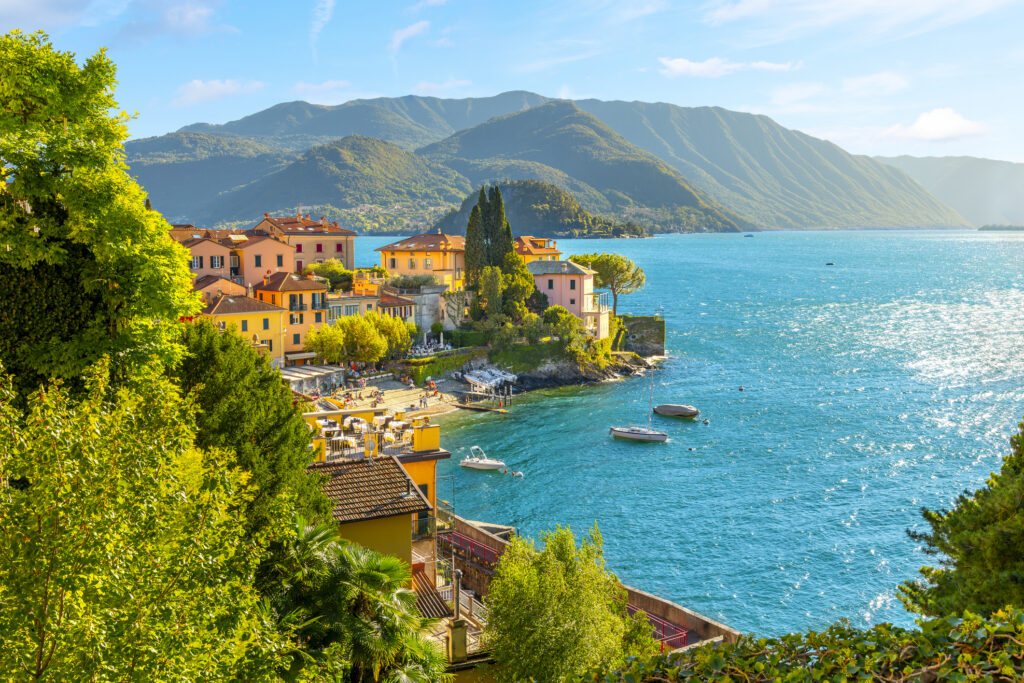
Perhaps Italy’s greatest gift is its natural beauty. From the dramatic mountain ranges that offer world-class hiking and skiing to its stunning, pristine coastlines, Italy is a place of inspiration in every season. It is not simply a destination, but a way of life.
Dual citizenship
Italy and the United States both allow dual citizenship.
Italy is in the European Union and the Schengen Area

Membership in the European Union and the Schengen area offer Italian citizens significant benefits.
The European Union
Countries within the European Union (EU) offer an extraordinary level of freedom and mobility. Under the EU’s freedom of movement rules, citizens of one member state can live and work in any other EU country (plus Switzerland, Norway, and Iceland) without the need for a visa. In practical terms, this means that Italian citizens can move seamlessly to France, Spain, Germany, Switzerland, or any other EU member state without restriction. For Americans who become EU Long-Term Residents in Italy, moving to another EU country is also possible through a simplified and streamlined process.
The Schengen Area
Italy is also part of the Schengen Area, a unique region where people, commerce, and capital move freely across borders without passport controls. This openness removes many of the barriers that exist elsewhere, making both everyday life and business significantly easier. It enables effortless travel, deeper integration, and a truly borderless European experience.
How Can I Move to Italy?

You can move to Italy with a Long-Stay Visa
Long-Stay visas
This is the most common pathway for Americans seeking to move to Italy. A visa is official authorization that allows you to live, work, and/or study in another country. Most visas are issued for a period of one year and can be renewed as long as you continue to meet the visa’s requirements. Without a visa, U.S. citizens can only visit Italy for tourism for up to 90 days, but cannot remain long-term, establish residency, or work.
How do Long-Stay Visas work?
Visa application
You must apply for a visa and submit detailed documentation demonstrating that you meet the qualifications for the specific category you are seeking. This process can be time-consuming and complex, which is why many people choose to work with Geostrata so they can remain focused on their careers, families, and daily lives.
Basic requirements
Most visas have a shared set of basic requirements. You must have enough income to cover your cost of living during your stay. The amount of income (and what kind of income) differs depending on your situation. You will also need to show proof of accommodation, which may be a leased apartment, a hosting arrangement with family or friends, or a home you own. Finally, everyone must apply for a Permesso di Soggiorno (residence permit) at a post office within eight (8) working days of arrival in Italy. Geostrata has deep expertise across the full range of visa pathways available to Americans. We carefully evaluate your background, objectives, and timeline to identify the option best suited to your circumstances.
Types of Long-Stay Visas

Italy Offers Many Options for Americans
- Retirees
- Digital nomads and remote workers
- Freelancers and self-employed people
- People who are hired to work at an Italian company
- Highly-qualified workers (EU Blue Card)
- Researchers and scientists
- Investors
- Students
- And more!
Spotlight: Italy's Retirement and Passive Income Visa

Spotlight: Italy's Retirement and Passive Income Visa
For People Who Don't Work
Italy’s Elective Residence Visa is designed for people who have reliable sources of passive income (like retirees). Passive income sources can include Social Security, pensions, real estate, business interests, retirement plans, and more. The income must be recurring and reliable. There is no age limit to apply for Italy’s Elective Residence Visa. Once in Italy, Elective Residence Visa holders are prohibited from working, which is why this visa is most suited to retirees.
Basic requirements
Applicants must have passive income from approved sources. Income from remote work does not qualify, and people who still work should consider a Digital Nomad Visa. Passive income (from all sources combined) must be at least $3,000 / month for a single person, and at least $3,600 for married couples. Geostrata’s attorneys will ensure that your income sources and documents meet government requirements before submitting your application.
You must have an approved private health insurance plan to apply, which you must hold until you are eligible to participate in Italy’s universal healthcare system. Geostrata has insurance partners who offer affordable coverage that meet’s Italy’s requirements, and we will help you prepare to enroll in public healthcare when the time comes.
You must also have proof of accommodation. Geostrata helps our clients find their dream home, apartment, or fully furnished short-term rental that fits within their budget.
Benefits
Retirees are permitted to enroll in Italy’s universal healthcare system after arrival and meeting a set of requirements. After living in Italy for five years, retirees are eligible to apply for E.U. Long-Term Residence (become permanent residents). The Elective Residence Visa is an incredible opportunity to retire in Italy with a direct pathway to long-term residence.
Spotlight: Italy's Digital Nomad Visa

For Digital Nomads and Remote Workers
Basic requirements
This visa is for people who earn money from their remote work. You can work as a remote employee or be self-employed. You must earn at least €25,000 per year from your remote work and be able to support yourself during your stay in Italy.
Benefits
The two main benefits of this visa are:
1. Your income from the United States is likely higher than it would be from an equivalent job in Italy. This allows you to enjoy the lower cost of living in Italy even more.
2. Since you are not competing with Italians for a job, it is significantly easier to move to Italy as a digital nomad than by obtaining employment in Italy.
Pathway to permanent residency
After five (5) years living in Italy a a digital nomad, you become eligible for EU Long-Term Residency (similar to permanent residency in the United States). As an EU Long-Term Resident, you can live in Italy without any restrictions, apply for any job, study at any institution, and move to another EU country through a streamlined procedure.
Spotlight: Italy's "Golden Visa" (Investor Visa)

For Investors and High-Net-Worth Individuals
- Invest €250,000 in an Italian innovative startup or
- Purchase €500,000 of shares of an active Italian company or
- Purchase €2,000,000 of Italian government bonds or
- Invest €1,000,000 in a public interest project
EU Long-Term Residency
Italian Citizenship


EU Long-Term Residency

Italian Citizenship

Ways to Obtain Italian Citizenship
Naturalization, Ancestry, and Marriage
Naturalization
To be eligible for Italian citizenship by naturalization, you must live in Italy for a period of at least ten years, pass an Italian language test, and demonstrate that you are financially stable.
Ancestry
Obtaining Italian citizenship through ancestry has been wildly popular in the United States for the past decade. Unfortunately, this method is more complicated than social media posts make it out to be, and the Italian government recently raised the threshold to be eligible. You might be eligible for Italian citizenship through ancestry if your parents or grandparents were Italian citizens at the time of your birth.
Marriage
If you are married to an Italian citizen, you are entitled to citizenship after a waiting period. If you already live in Italy, than you are eligible for citizenship two years after the marriage was registered with the Italian government. This is reduced to one year if you have children with your Italian spouse. If you live with your Italian spouse outside of Italy, then you are eligible for Italian citizenship thee years after the marriage was registered with the Italian government. This is reduced to 1.5 years if you have children with your Italian spouse.

Relocating to Italy: A Complete E-Book Guide for Americans
Available in our bookshop!
Long-Stay Visas
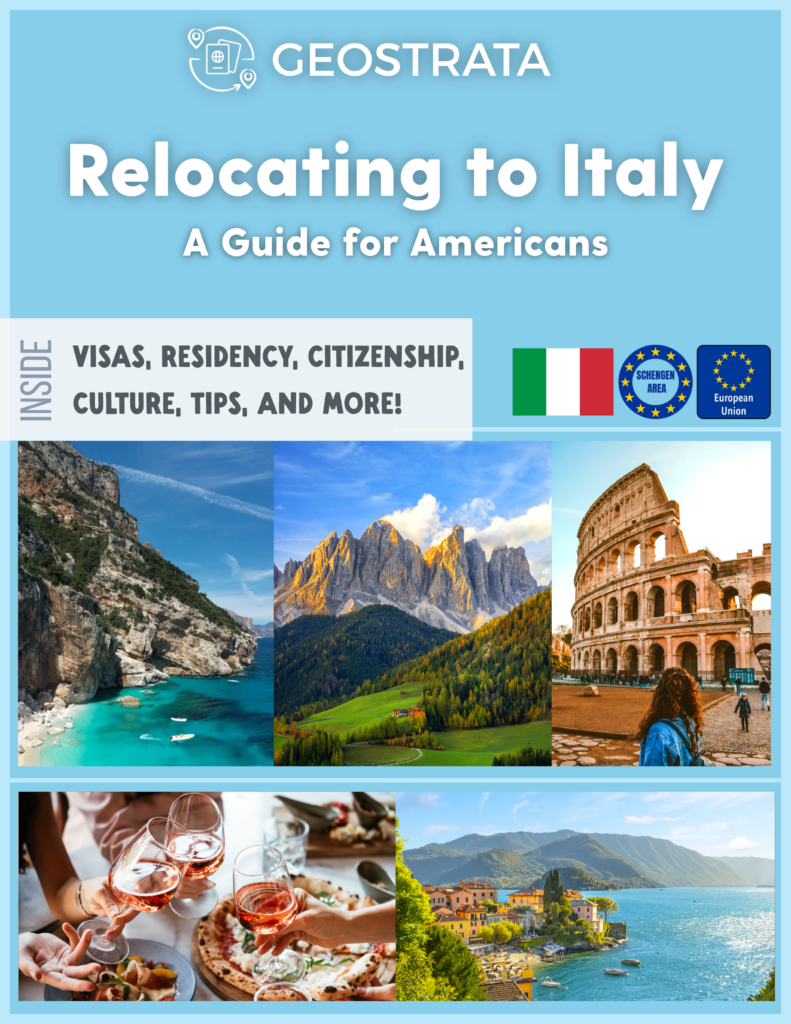
Relocating to Italy: A Guide for Americans covers all of the long-stay visa options for Americans and their requirements, updated for 2026!
E.U. Long-Term Residence
Our eBook explains the benefits of E.U. Long-Term Residence and what is required to apply in Italy.
Italian Citizenship
Relocating to Italy: A Guide for Americans includes an entire section dedicated to all of the pathways to Italian citizenship. Additionally, the citizenship by ancestry route is clearly explained with updates for the rule changes that took place in 2025.
Cultural Considerations and Integration
We dedicated a section to cultural considerations and integration. This section is designed to set realistic expectations for the integration process, and to help you build confidence!
Italy's History and Cultural Context
To think like an Italian, you have to understand the key events in Italy’s recent history. We dedicated an entire section to these events, as well as Italy’s regions.
The European Union and the Schengen Area
After speaking with hundreds of clients, we realized that many people don’t know the benefits of Italy’s membership in the European Union and the Schengen Area. This section explains the benefits and the information that you need to know.

contact us
Contact us with your questions
We would love to speak with you! Feel free to reach out with any questions.

get in touch
Schedule a free consultation
Schedule a free consultation with our team and start your journey!