

Written by Valentina Acosta
Healthcare in Italy for Americans over 50 can be both dependable and affordable, but access is not automatic simply because you have moved there with a visa. It’s your residence status that will determine whether you must join Italy’s public healthcare system, may enroll voluntarily, or need private health insurance.
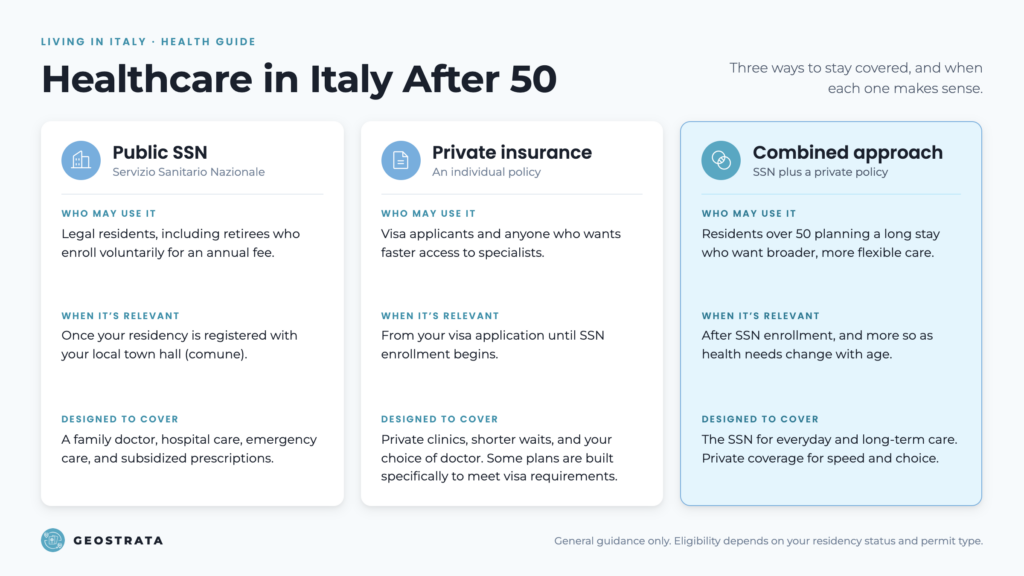
For Americans moving to Italy after 50, the practical plan often has two stages. You may first need visa-compliant private insurance before arrival. Once resident, you may qualify for mandatory or voluntary enrollment in the Servizio Sanitario Nazionale, or SSN. Some residents continue using private care alongside the public system for faster appointments, a preferred specialist, or an English-speaking provider.
As with everything, the right arrangement depends on your visa, region, medical needs, and patience. It’s best to plan these decisions before you leave the United States, especially if you take regular medication or need ongoing specialist care.
How Healthcare in Italy Works for American Residents
Italian healthcare for expats isn’t separate from the national scheme. Italy’s SSN is a tax-funded, regionally administered public system, and access depends on residence status. The national government defines the essential levels of care, while regions and local health authorities, known as ASLs, organize and manage services. Eligible residents generally register through the ASL responsible for where they live and can then choose a primary care doctor.
As for coverage, the public system includes primary care, hospital treatment, and many specialist, diagnostic, rehabilitation, and prescription services. Given it’s a tax-funded system, care is often free at the point of use, although co-payments called tickets may apply. Dental care and some outpatient services have more limited public coverage, one of the reasons why some residents sometimes pay directly or prefer to use private insurance.
The system is national, but the experience is local. This means that waiting times, staffing, access, and service quality will vary from one region to another. When comparing places to live, it’s better to evaluate nearby hospitals, primary care capacity, specialist access, transportation, and year-round services in the specific region you are interested in rather than relying only on a national ranking, especially if you need regular hospital visits or care.
Your Residence Status Determines Your Coverage

According to Italy’s official visa portal, foreign residents with permits for employment, self-employment, adoption, or family reasons must register with the SSN, meaning they are entitled to public healthcare on the same terms as an Italian citizen. Other residents may need private healthcare or may be able to enroll voluntarily by paying an annual contribution. The specific route depends on the residence permit and the rules applied by the relevant ASL.
If you are applying for elective residence, don’t assume that future access to the SSN removes the insurance requirement at the visa stage. For example, the Italian Consulate in Chicago requires proof of overseas health insurance covering all medical expenses. Other consulates publish their own documentation standards, so confirm the current checklist for your U.S. jurisdiction before spending on insurance.
For Americans researching healthcare for retirees in Italy, bear in mind that Medicare is not a substitute for Italian coverage. Medicare usually does not cover healthcare outside the United States, apart from limited exceptions. Review any Medigap, retiree, or employer coverage separately and decide whether maintaining U.S. insurance still makes sense for visits or a possible return, if applicable.
Public, Private, and Combined Healthcare Compared
| Approach | May suit | What it offers | What to confirm |
|---|---|---|---|
| Public SSN | Residents entitled to mandatory or voluntary enrollment | Primary doctor, public hospitals, and covered services | Permit eligibility, ASL documents, tickets, and local access |
| Private insurance | Visa applicants and residents wanting broader private access | Coverage defined by the policy and provider network | Visa compliance, exclusions, limits, deductibles, and renewability |
| Private self-pay care | Residents seeking a specific clinician or faster routine appointment | Direct access to private providers at the stated fee | Prices, language, reimbursement, and follow-up care |
| Combined approach | SSN members who also want private flexibility | Public coverage plus selected private consultations or insurance | Which services are worth supplementing in your region |
Choosing Private Health Insurance for an Italy Visa
When comparing health insurance for a visa, remember that a policy useful for travel may not (and probably will not) satisfy longer stays. Ask the insurer to confirm in writing that the coverage meets the current requirements published by your consulate. Make sure you review the geographic area, start and end dates, hospitalization, emergency treatment, repatriation, and other specifics. You don’t want to have any unpleasant surprises later.
Pay particular attention to pre-existing conditions and ongoing treatment. A certificate may look comprehensive but the fine print may exclude the care you are most likely to need. If you plan to use the policy after arrival, check its Italian provider network, claims process, direct-billing arrangements, customer support, and whether English-language assistance is available.
Geostrata ensures our clients have health insurance that meets their needs and satisfies their visa’s requirements. We work with European insurance companies and insurance brokers to offer easy access to a variety of policies and healthcare experts.
Preparing Prescriptions and Ongoing Treatment
Planning prescriptions in Italy requires more than carrying a U.S. supply. Moving countries means you need to learn a lot of things from scratch, and the name of the medication you usually take is likely to be one of them. Don’t assume that brand names, dosages, or prescriptions transfer unchanged. Before moving, ask your physician for a concise medical summary and a medication list showing each active ingredient, strength, dosage, and reason for use. With this information, it’s easier for your new clinician to identify the medication you need.
Controlled medicines need additional care. Italy’s Ministry of Health requires travelers carrying certain narcotic or psychotropic medicines for personal use to hold documentation proving that the medicine was lawfully obtained. Confirm the current documentation and quantity rules before departure rather than traveling with an unexplained supply.
If a medicine is not marketed in Italy or becomes unavailable, importing it may involve an Italian doctor, the ASL, a hospital pharmacy, or another health authority. Check that this can be done before your supply runs out.
Your Healthcare Checklist Before Moving
- Confirm how your planned visa and residence permit affect SSN enrollment and private insurance.
- Compare policies using the consulate’s current wording, not a generic travel-insurance description.
- Collect medical summaries, test results, and contact details for current clinicians.
- Create a medication plan using generic names and verify Italian availability, prescribing rules, and controlled-drug documentation.
- Research primary care, hospitals, specialists, pharmacies, dental care, vision care, and transportation near your intended home.
- Budget for premiums, SSN contributions if applicable, tickets, private consultations, dental and vision care, and treatment in the United States if you plan to keep it.
Build Healthcare Into the Relocation Plan
Healthcare planning should happen alongside your visa and location decisions. Younger people tend to not worry too much about healthcare when they move to a new country, but there’s a point where healthcare becomes one of the main factors in the relocation decision. The residence route determines the insurance framework, while the region and town affect which doctors, hospitals, and specialists are practical for daily life. A home that looks ideal on vacation may be less suitable if routine care requires long drives or repeated private appointments.
If you need support to coordinate visa-compliant insurance, residence formalities, or other aspects of relocating, feel free to book a consultation with Geostrata to discuss your move to Italy and build a comprehensive relocation plan that accounts for your residence route, location, medical priorities and other needs.
